
Protect Yourself
Use caution when handling wild game. They may carry diseases that can be transmitted to humans. Protect yourself by always wearing rubber or latex gloves. Be sure to wash your hands with soap and water after handling.
Field Care Essentials (Proper care and handling)
Proper field care is the critical first step in ensuring that your mount will be of the highest quality. Hiring the right taxidermist is essential; however, even the most experienced taxidermist can only do so much if proper field care is not performed. Improper field care may result in hides being lost in the tanning process or may affect the outcome of your trophy.
Decomposition begins with death. Bacteria and internal chemicals and enzymes begin breaking down tissues. It is imperative that the animal is cooled down as quickly as possible to decrease the rate of decomposition. This is especially true with antelope and early season animals.
When gutting your trophy, do not cut up through the brisket. As a general rule, do not salt a skin after removal. It is best to bring your skin to a taxidermist as soon as possible. If it is necessary for you to salt the skin, salt ONLY after it has been properly fleshed and everything is turned out. Failure to properly flesh and turn out the skin may result in loss of the hide.
After cooling, freeze all skins as quickly as possible to avoid damage.
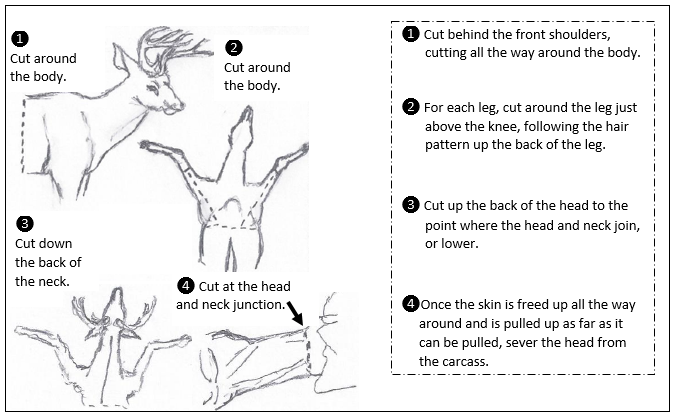
Caping for a Shoulder Mount
Skinning for Life-size Mounts (Large Game)
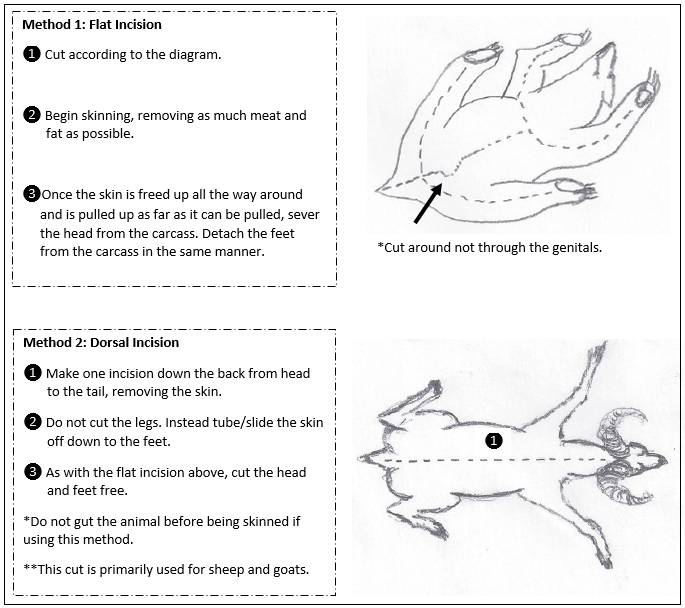
Skinning – Small Game
For animals the size of a coyote or smaller, simply ice down the animals as soon as possible. DO NOT gut the animal. Small mammals, especially carnivores, will spoil very quickly. If it is not possible to get a small game animal to a taxidermist right away, then after cooling the animal completely, put the animal in a plastic bag and freeze it.
Once again, take extreme care when handling these animals due to the fact they could be infected with rabies or other disease.
Birds
To minimize damage, avoid allowing your dog to mouth the bird more than is necessary. If possible collect the bird yourself to limit the damage. Do not carry the bird by its neck and do not wring its neck as this can cause damage to the feathers. It is best to carry the bird by the feet. After rinsing blood from the feathers with water, cool as soon as possible. Do not gut the bird. Bring it to a taxidermist immediately or freeze it. When freezing, put cotton inside the mouth and place the head under a wing Place the bird into a plastic bag. Remove as much air as possible. Do not bend the bird’s tail feathers when freezing. Instead, let the tail feathers stick out of the bag and loosely tie the bag.
Fish
For both skin mounts and reproductions, take pictures as soon as the fish is caught as fish can lose color almost immediately. Photos will help when replicating and capturing the beauty of the fish in the mount.
Do not gut the fish. Wrap it in very wet towels and put it into a plastic bag, making sure that the fins are flat to the body. Freeze the fish.
Important Notes
- When bringing your trophy to a taxidermist, make sure that all appropriate tags accompany your trophy. Migratory birds require the hunter’s name, address, type of bird, where the bird was taken, date the bird was taken, license number, and signature.
- Be aware, that although this doesn’t occur often, despite a hunter’s best field care, problems with a skin may arise due to a myriad of factors including but not limited to: sickness; time of year; too much moisture; etc.
- Executing the proper field care must be a top priority. Although you may be tempted to share your experience and trophy with others, doing so before proper field care may result in irreversible damage.